

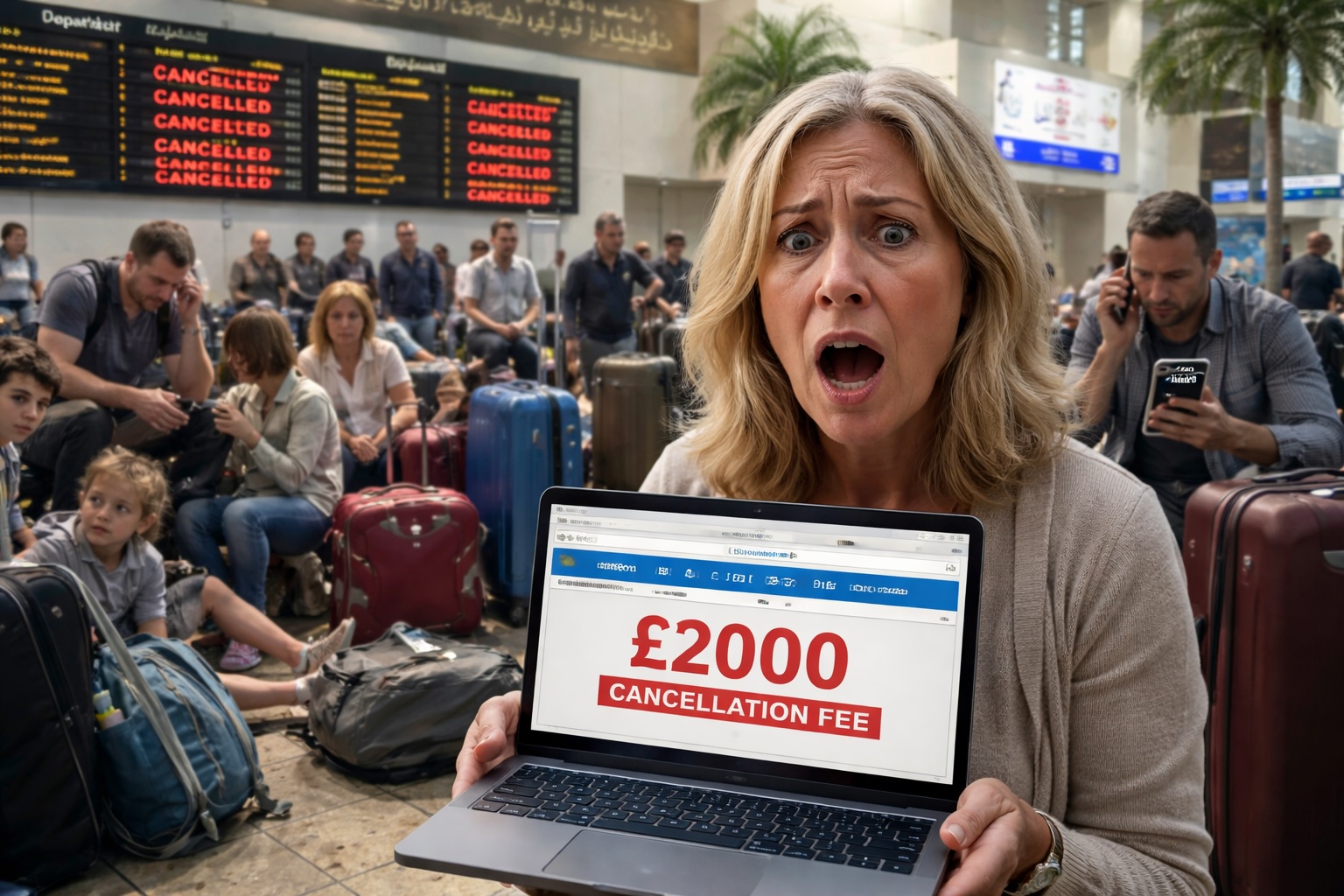
While airlines suspend operations, loveholidays forces customers to pay thousands or travel to active conflict zones despite government warnings
As the Middle East erupted into conflict and airlines grounded flights across the region, one company’s response has shocked the travel industry: loveholidays, one of the UK’s largest online travel agents, is demanding £2,000 cancellation fees from customers who want to avoid traveling to active war zones.
While Qatar Airways strands passengers and Emirates scrambles to evacuate travelers, loveholidays has chosen a different approach entirely—forcing customers to choose between traveling to conflict areas or paying devastating financial penalties for trying to stay safe.
The company’s response to the humanitarian crisis has exposed a shocking pattern of customer abandonment, profiteering from fear, and corporate callousness that puts profit over passenger safety during one of the most serious travel disruptions since COVID-19.
The £2,000 Extortion Scandal
The most damning evidence of loveholidays’ crisis failures comes from customers who discovered the company’s true priorities when they tried to cancel trips to the Middle East as missiles and drones filled the skies.
Multiple customers report being told they must pay cancellation fees of approximately £2,000—for holidays where they had only paid £200 deposits.
“My daughter and her boyfriend had just put down a mere £200 deposit on a package holiday to UAE when the situation out there escalated,” one customer wrote on Trustpilot. “On contacting Love Holidays in an attempt to cancel, they were told their only options were to either pay a cancellation fee of approx £2,000.”
The customer noted that “the vast majority of the cost of the package seemed to have been allocated to the flights, rather than the hotel”—suggesting loveholidays deliberately structures bookings to maximize cancellation penalties.
This isn’t an isolated incident. Another customer reported being told flatly: “you have to go unless guidance changes” despite Foreign Office advice against all but essential travel to conflict zones.
The message is clear: pay thousands to escape, or risk your safety in a war zone.
Forcing Customers Into Danger
Despite the Foreign, Commonwealth & Development Office (FCDO) advising against all but essential travel to UAE, Qatar, Kuwait, Bahrain, and Jordan, loveholidays is actively pressuring customers to travel to these conflict areas.
Customer reviews reveal the company’s shocking response to legitimate safety concerns:
“I am due to go to the Middle East in two weeks and tried to contact LH to cancel due to the recent conflict and guidance to avoid travelling and for essential travel only. To essentially be told you have to go unless guidance changes,” wrote one frustrated customer.
The absurdity is staggering: the UK government says avoid these areas unless absolutely essential, but loveholidays says you must go anyway or pay massive financial penalties.
This policy effectively forces customers to choose between their safety and their savings—a choice no travel company should ever force customers to make during a humanitarian crisis.
Customer Service Collapse
When customers desperately need help during the crisis, loveholidays’ customer service has completely collapsed into dysfunction that borders on deliberate obstruction.
Multiple customers report identical patterns of systematic customer service failure:
Wait Times Over An Hour: “I have been waiting up to hour, but agents could not give to me any information i am interested in,” reported one customer trying to modify their Middle East booking.
Agents Logging Off Mid-Conversation: “I tried to contact via online chat—agents keep logging off—impossible to continue conversation. They just logged off without asking if i have more questions.”
Refusing Supervisor Access: When customers ask to speak to supervisors about crisis situations, “the agents refused to transfer the call, claiming there was no need. Clearly, there is a need when no one is helpfully resolving the situation.”
Generic Copy-Paste Responses: Rather than addressing genuine crisis concerns, “They provide generic, template replies instead of real resolutions” that avoid answering basic questions like “Will you rebook us?” and “When will we fly home?”
Department Communication Breakdown: “The departments do not communicate to each other, do not pass the information to each other” leaving customers repeating themselves endlessly without resolution.
This isn’t poor customer service—it’s systematic customer abandonment designed to exhaust people into giving up legitimate claims for help.
Abandoning Legal Responsibility
Perhaps most shocking is loveholidays’ attempt to abandon their legal responsibilities as package organizers during the crisis by telling customers to solve problems themselves.
Under UK Package Travel Regulations 2018, package organizers like loveholidays are legally responsible for helping customers when disruptions occur. But customers report the company is systematically dodging these obligations:
“Instead of resolving the issue, I am repeatedly being told to contact the hotel or the airline myself. This makes no sense. The booking was made through loveholidays. The payment was made to loveholidays,” wrote one stranded customer.
Another reported: “Rather than proactively resolving the issue, interactions feel designed to exhaust customers into giving up on legitimate claims.”
When customers cite their legal rights, loveholidays responds with “silence. Glorious, echoing silence” according to one frustrated traveler who referenced EU Package Travel Directive protections.
This systematic abandonment of legal responsibility during a crisis suggests loveholidays views customer protection laws as inconveniences to be ignored when compliance becomes expensive.
Profiteering From Humanitarian Crisis
While airlines lose billions suspending operations for passenger safety, loveholidays has found a way to profit from the humanitarian crisis: maintaining full cancellation fees despite active warfare.
The company’s own website confirms their mercenary approach: “as the FCDO isn’t advising against travel to the UAE, our amendment and cancellation fees will still apply.”
This hair-splitting approach to government warnings means loveholidays will only waive fees if the FCDO explicitly says “do not travel” rather than “avoid all but essential travel”—allowing them to collect penalties while customers travel through missile strikes and drone attacks.
The policy reveals a company more interested in parsing language for profit than protecting customer welfare during genuine emergencies.
The Human Cost of Corporate Callousness
Behind the cancellation fees and abandoned customer service are real people whose lives have been devastated by loveholidays’ crisis response.
One customer described the emotional toll: “This experience has turned what was meant to be a nice family holiday into a nightmare, and we’re uncertain whether it will go ahead at all.”
Another wrote about the financial impact: “They took over 2k gladly, but when issues arise, they are unwilling to assist us, which is quite disconcerting.”
For families trying to protect their safety during active conflict, loveholidays’ response adds insult to injury: “Customer service keeps telling us we need to wait and that they’ve noted the account to prioritize a callback the same day. Yet, so far, five days have passed without a callback and nothing has changed.”
These aren’t just booking problems—these are families being financially punished for trying to avoid traveling through war zones while receiving no support from the company they trusted with their money.
Abandoning Customers Already Trapped in Qatar
Perhaps most shocking is how loveholidays treats customers who are already stranded in Qatar during the crisis. Multiple customers report that the company has completely abandoned people who are trapped in the conflict zone and desperately need help getting home.
Systematic Phone Abandonment Customers stuck in Qatar report that loveholidays’ phone system is designed to frustrate rather than help. Callers describe being put on hold for hours before the system automatically disconnects them without speaking to anyone.
“I’ve been calling from Qatar for three days trying to get help,” one stranded customer reported. “Every time I wait for over an hour, then the phone just cuts off. No one ever answers, no one ever calls back.”
Another trapped customer said: “They keep you waiting on the phone until you give up or get disconnected. It’s like they’re trying to avoid talking to people who actually need help.”
Live Chat Deliberately Disconnects Users The company’s live chat system appears deliberately designed to prevent customers from receiving actual assistance. Multiple users report being immediately disconnected when they try to explain their situation.
“The live chat connects, then as soon as I explain I’m stuck in Qatar and need help getting home, it disconnects,” one customer wrote. “This has happened eight times in two days. It’s not a technical problem—they’re deliberately cutting people off.”
Zero Help for Stranded Customers Despite marketing themselves as customer-focused, loveholidays appears to have provided no meaningful assistance to customers actually trapped in Qatar during the crisis.
Stranded customers report:
- No proactive contact from loveholidays about evacuation options
- No assistance rebooking flights with other airlines
- No help accessing hotels or accommodation during extended stays
- No response to emergency contact requests
- No coordination with UK government evacuation efforts
“I’ve been stuck in Doha for a week and loveholidays has done nothing,” one customer explained. “Other travel companies are helping their customers get home, but loveholidays just ignores us completely.”
This abandonment of customers already in crisis zones represents perhaps the most damning evidence of loveholidays’ true priorities. While charging £2,000 fees to avoid traveling to Qatar is outrageous, completely abandoning customers already trapped there during active conflict is unconscionable.
Industry Comparison: How Others Handle Crises
Loveholidays’ crisis response looks even worse when compared to how legitimate travel companies handle emergencies.
While loveholidays demands £2,000 penalties for avoiding conflict zones, other companies have:
- Airlines: Even embattled Qatar Airways offers “complimentary date changes of up to 14 days from the original travel date, or refund of the unused value of your ticket” for affected passengers
- Emirates: Resumed operations specifically to help stranded passengers evacuate safely
- Government Repatriation: Multiple countries organized free evacuation flights for citizens trapped in the region
The contrast is stark: actual airlines losing billions are offering more customer support than loveholidays, which profits from forcing customers into danger zones.
Customer Reviews Tell the Full Story
Trustpilot and other review sites reveal the systematic nature of loveholidays’ customer abandonment during the crisis:
“As a package customer, our contract is with the organiser (loveholidays)—not the airline. The lack of clear accountability, delayed responses, and failure to provide decisive assistance at a critical time has been deeply stressful and unacceptable.”
“Being stranded in another country is stressful enough without having to fight your package organiser for basic assistance. At this stage, we are simply asking for what was paid for: safe and timely return travel.”
“They are quick to take your money but disappear the moment something goes wrong. Their customer service is fragmented, unhelpful, and dismissive—even when the mistake is clearly theirs.”
The reviews paint a picture of a company that excels at taking money but systematically fails customers when they need help most.
The Legal and Ethical Questions
Loveholidays’ crisis response raises serious questions about both legal compliance and corporate ethics:
Legal Issues: Are they violating Package Travel Regulations by refusing to assist customers during disruptions? Are £2,000 cancellation fees for £200 deposits legally enforceable penalty charges?
Ethical Questions: Is it morally acceptable to profit from fear by charging massive fees for avoiding war zones? Should travel companies force customers to risk their safety for corporate profit?
Regulatory Concerns: Should ATOL protection cover companies that abandon customers during crises? Do current travel regulations adequately protect consumers during emergencies?
The crisis has exposed gaps in both corporate behavior and regulatory oversight that leave customers vulnerable to exploitation during their most desperate moments.
What This Reveals About LoveHolidays
The Middle East crisis has stripped away loveholidays’ marketing veneer to reveal a company whose priorities become clear when tested:
Profit Over Safety: Charging £2,000 fees for avoiding conflict zones shows profit comes before passenger welfare
Legal Dodging: Systematically telling customers to contact airlines/hotels directly violates package organizer responsibilities
Customer Abandonment: Designing customer service to exhaust rather than assist customers during crises
Crisis Profiteering: Maintaining full fees during humanitarian emergencies while competitors offer assistance
Corporate Callousness: Treating customer safety concerns as inconveniences rather than legitimate requests for help
For future travelers, loveholidays’ crisis response provides crucial insights into how the company treats customers when they need help most. The answer appears to be: badly.
The Broader Industry Problem
Loveholidays’ failures are part of a broader pattern of travel industry customer abandonment during the Middle East crisis. While airlines like Qatar Airways strand passengers and prioritize wrong passengers, companies like loveholidays profit from customer fear.
The crisis has revealed that many travel companies view customer protection as optional expenses to be avoided during emergencies rather than core responsibilities to be maintained regardless of cost.
This systematic failure suggests travelers need stronger legal protections and regulatory oversight to prevent companies from abandoning customers during their most vulnerable moments.
Latest Crisis Updates: IPO Disaster and Policy Changes
BREAKING: £1 Billion IPO Delayed Due to War Chaos
The scale of loveholidays’ crisis mismanagement became clear this week when the company was forced to delay its planned £1 billion stock market flotation specifically because of the Middle East war disruption. The company had planned to announce its London Stock Exchange listing in early March 2026, but the travel chaos caused by their poor crisis response has now forced a postponement until at least after Easter.
This IPO delay represents a massive corporate embarrassment—when your crisis handling is so bad it derails a billion-pound stock listing, it reveals the true scale of management failures.
Updated Policies Still Fail Customers
Under pressure, loveholidays has been forced to extend their cancellation deadlines, now offering full refunds for holidays up to March 15, 2026 (originally March 10) to UAE, Kuwait, Bahrain, Qatar and Jordan. However, for any trips after March 15, the company is still maintaining full cancellation fees unless the FCDO specifically changes advice.
This means customers are still being forced to choose between paying thousands in penalties or traveling to active war zones—the company has only pushed back the exploitation timeline, not eliminated it.
The Bigger Picture: A Company in Crisis
Shocking Performance Statistics
While loveholidays promotes a 4.3/5 Trustpilot rating, the reality is far worse:
- 14% of reviews are 1-star (over 35,000 negative reviews out of 252,000 total)
- Ranked #186 of 210 in the travel agent category—near the bottom of the industry
- Over 4 million customers annually means potentially 560,000 unhappy customers per year based on their negative review rate
- 98% response rate to negative reviews suggests they spend more time managing their image than preventing problems
These statistics reveal a company with systematic customer service problems that go far beyond the current Middle East crisis.
Industry-Wide Recognition of Failure
The crisis has damaged loveholidays so severely that major financial institutions advised on their IPO—including Rothschild, Barclays, JPMorgan and Investec—have all had to postpone what was expected to be 2026’s first major London Stock Exchange listing.
When your crisis response is so poor it forces blue-chip investment banks to delay a billion-pound flotation, it demonstrates failure on a scale that goes beyond individual customer complaints to corporate reputation destruction.
Looking Forward: Trust Destroyed
Loveholidays’ response to the Middle East crisis may prove to be a defining moment for the company—not for exceptional customer care, but for demonstrating how a travel company can systematically fail its customers during genuine emergencies.
The £2,000 cancellation fee scandal, customer service collapse, abandonment of legal responsibilities, and resulting IPO disaster have created a permanent record of corporate priorities that will follow the company long after the current crisis ends.
For travelers considering future bookings, loveholidays’ crisis response provides sobering insights into how the company treats customers when they need help most. The evidence suggests that once loveholidays has your money, getting help during emergencies becomes your problem, not theirs.
As thousands of customers discover that avoiding war zones costs £2,000 through loveholidays, the company’s response to this humanitarian crisis will likely be remembered as a masterclass in how travel companies can profit from customer desperation while abandoning every pretense of caring about passenger welfare.