

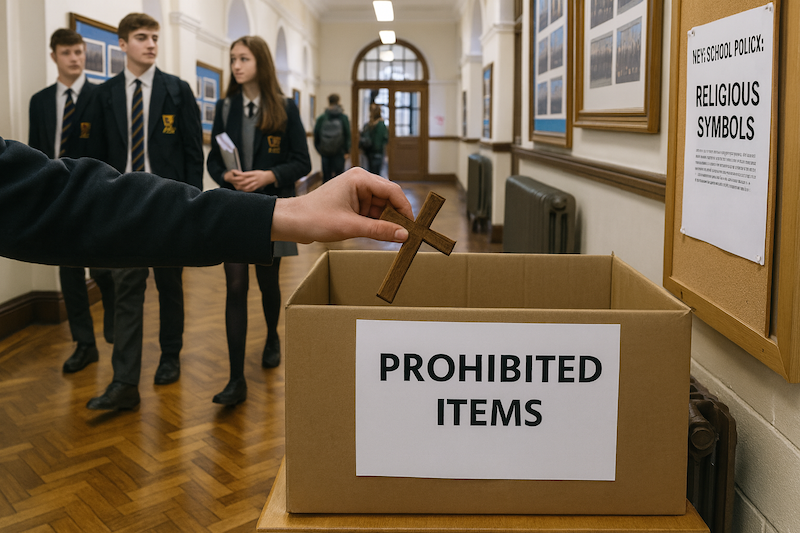
On November 19, 2025, the UK Supreme Court delivered a landmark ruling that has ignited fierce debate across Northern Ireland and beyond. The decision, concerning how religious education is taught in Northern Ireland’s state-controlled schools, has led to widespread confusion about what the ruling actually means for Christian teaching in the classroom.
Within days of the judgment, petitions emerged calling for the protection of Christian teaching in Northern Ireland schools, with supporters claiming the court had effectively banned Christianity from education. But did it?
What the Supreme Court Actually Ruled
The case, known as JR87, involved a child who attended a state-controlled primary school in Belfast between the ages of four and seven. Her parents, who describe themselves as “broadly humanist,” raised concerns in 2019 that their daughter was being taught Christianity as absolute truth rather than as one perspective among many.
The Supreme Court’s unanimous decision found that the way Christian religious education and collective worship were being delivered in Northern Ireland’s state-controlled schools violated the European Convention on Human Rights. Specifically, the court ruled that the teaching was not “objective, critical, and pluralistic” as required by law.
Justice Ben Stephens, delivering the judgment, stated that teaching pupils “to accept a set of beliefs without critical analysis amounts to evangelism, proselytising, and indoctrination” – which the court deemed unlawful in state-funded education.
The Critical Distinction: Unlawful vs. Banned
Here’s where the confusion begins. The court did not ban Christian teaching from schools. Judge Lord Stephens explicitly clarified that the judgment “was not about secularism in the education system” and emphasized that “no one is suggesting that religious education should not be provided in schools in Northern Ireland.”
The Evangelical Alliance, a major Christian organization in the UK, urged believers “not to panic” and to view the ruling as an opportunity for renewed engagement. Their statement noted: “The court’s ruling means schools will continue to teach about Christianity but in a more ‘objective, critical and pluralistic manner.'”
The distinction is crucial: Christianity can still be taught in Northern Ireland schools, but it must be presented alongside other worldviews and beliefs, rather than as the only truth students are expected to accept.
The Historical Context
To understand why this case reached the Supreme Court, it’s important to examine Northern Ireland’s unique educational landscape. Unlike the rest of the UK, Northern Ireland’s education system remains deeply shaped by its sectarian past.
The current Core Syllabus for Religious Education, dating back to 1993, was exclusively Christian in content and authored by the four largest Christian denominations. It begins with “Learning Objective 1: The Revelation of God” and is described as “Bible-based.”
State-controlled schools (predominantly Protestant-linked) are required to follow this Christian curriculum and conduct daily Christian collective worship. Catholic-maintained schools, which operate under different legislation, are not affected by this ruling and can continue their denominational approach.
This system made sense when Northern Ireland was overwhelmingly Christian, but the religious landscape has shifted dramatically. The 2023 Northern Ireland Life and Times Survey revealed that 26% of the population now identifies as non-religious – up from just 13% a decade ago. This puts non-religious people at nearly the same level as Catholics (34%) and Protestants (35%).
The Journey Through the Courts
The case had a complicated journey through the legal system. In 2022, the Belfast High Court initially ruled in favor of the family, finding that the Christian RE taught in Northern Ireland schools was indeed unlawful. However, the Court of Appeal overturned this decision, arguing that parents’ right to withdraw their children from religious education was sufficient protection.
The Supreme Court disagreed with the Court of Appeal’s reasoning. The justices found that requiring parents to withdraw their children placed an “undue burden” on families and risked stigmatizing children who opted out. They concluded that the opt-out mechanism could not justify teaching that amounted to religious indoctrination.
Darragh Mackin, the solicitor representing the child and her parents, described the Supreme Court decision as a “watershed moment for educational rights in this jurisdiction.” He noted that the judgment “makes clear that the State cannot rely on withdrawal mechanisms to justify religious instruction.”
What Changes Now?
The immediate practical implications of the ruling remain somewhat unclear, as the Northern Ireland Department of Education must now determine how to comply with the judgment. However, several changes appear inevitable:
Curriculum Revision
The existing Core Syllabus for Religious Education will likely require significant revision. This could involve greater input from non-Christian faith communities and non-religious organizations like Humanists UK. Christianity may remain a major focus, given its historical and cultural importance in Northern Ireland, but it will need to be taught alongside other perspectives.
Collective Worship Reform
Daily Christian collective worship may need to be restructured or replaced with more inclusive assemblies that accommodate students of all beliefs and none. Schools may need to shift from worship to exploration of different worldviews.
Enhanced Monitoring
The court criticized the Department of Education’s lack of adequate monitoring of religious education and collective worship. This may result in new inspection systems or tighter oversight of how religious education is delivered.
Teacher Training
Educators may require new training on how to teach about religion in an objective and pluralistic manner that respects diverse beliefs while avoiding indoctrination.
Reactions From Key Stakeholders
Christian Organizations
Peter Lynas of the Evangelical Alliance struck a measured tone, acknowledging concerns while identifying positive elements in the ruling. The court affirmed that “historically and today, Christianity is the most important religion in Northern Ireland” and recognized parents as the primary influence on their children’s beliefs.
Lynas argued that “Christians should have confidence in the gospel as good news as part of a more plural framework” and noted that many schools already teach Christianity in balanced ways. He suggested that churches and Christian organizations can contribute to developing new syllabi, ensuring Christian perspectives remain “central and accurately represented.”
Humanist Organizations
Northern Ireland Humanists welcomed the decision, having campaigned for inclusive religious education that treats non-religious perspectives equally with religions. The organization has long argued that mandating Christian worship is “unfair, exclusionary, and out of step with modern human rights principles.”
They point out that opt-out provisions don’t work effectively because they single out children and exclude them from important communal activities. The Supreme Court’s acknowledgment of this problem validates concerns humanist groups have raised for years.
Education Authorities
The Northern Ireland Department of Education has not yet announced detailed plans for compliance but will need to work with schools, religious organizations, and non-religious groups to develop a new framework that satisfies the court’s requirements.
Implications Beyond Northern Ireland
While this ruling specifically addresses Northern Ireland, it has potential ramifications for the rest of the United Kingdom. England, Wales, and Scotland all have laws requiring Christian collective worship in schools, though the requirements vary by nation and enforcement is often lax.
The Supreme Court’s clear statement that the right to withdraw cannot justify indoctrination may embolden challenges to similar arrangements elsewhere in the UK. Humanist organizations have been campaigning for over a decade to repeal mandatory Christian worship requirements across all four UK nations.
The case also reflects broader European trends toward religious neutrality in state education. The European Court of Human Rights has consistently emphasized that states must ensure religious instruction is “objective, critical, and pluralistic” and must avoid indoctrination.
Addressing Common Misconceptions
Misconception 1: The Court Banned Christianity from Schools
Reality: The court did not ban Christian teaching. It ruled that Christianity must be taught objectively alongside other beliefs, rather than presented as absolute truth that students must accept.
Misconception 2: This is About Removing Religion from Education
Reality: The judgment explicitly supports teaching about religions, including Christianity. It requires teaching to be balanced and respectful of diverse viewpoints, not secular.
Misconception 3: Parents Lost All Say in Their Children’s Religious Education
Reality: The court affirmed that parents remain the primary influence on their children’s religious beliefs. The ruling protects parental rights by ensuring schools don’t indoctrinate children against their families’ convictions.
Misconception 4: Catholic Schools Are Affected
Reality: The ruling applies only to state-controlled schools in Northern Ireland. Catholic-maintained schools operate under different legislation and can continue their denominational religious education.
Misconception 5: This is an Attack on Christian Values
Reality: The case was brought by parents seeking balanced education that respects multiple perspectives, not by anti-Christian activists. Many Christian leaders view it as an opportunity to engage more effectively in diverse contexts.
Looking Forward: Opportunities and Challenges
The Supreme Court ruling presents both challenges and opportunities for Northern Ireland’s education system.
Challenges
Developing a new curriculum that satisfies the court’s requirements while respecting Northern Ireland’s Christian heritage will require careful negotiation among diverse stakeholders. Schools will need resources and training to implement changes effectively. Some parents and communities may resist modifications to longstanding practices.
Opportunities
The ruling creates space for more honest engagement with Northern Ireland’s growing religious diversity. Students may develop better critical thinking skills about religion and worldviews. The changes could reduce tensions between schools and families with different beliefs, creating more inclusive learning environments.
As Peter Lynas noted, “if done well, [this approach] will allow the truth and hope of Christianity to shine” as students encounter it alongside other perspectives and can make informed decisions about their beliefs.
The Bottom Line
The UK Supreme Court’s November 2025 ruling represents a significant shift in how Northern Ireland approaches religious education, but it is not the ban on Christian teaching that some have characterized it as.
Christianity can and will continue to be taught in Northern Ireland schools. What must change is how it’s taught – moving from a model that assumed all students would accept Christian beliefs to one that educates students about Christianity and other worldviews in an objective, balanced manner.
For some, this represents an unacceptable dilution of Christian influence in education. For others, it’s a necessary recognition of Northern Ireland’s changing religious landscape and a requirement of human rights law.
What’s certain is that the debate over how to implement this ruling will shape Northern Ireland’s education system for years to come. The key question isn’t whether Christianity has a place in schools – the court has confirmed it does – but how that place is defined in a society that is increasingly diverse in its beliefs and increasingly committed to respecting the rights of all its citizens.
Tags: Northern Ireland, Religious Education, Supreme Court, Christianity, Education Policy, Human Rights, JR87 Case, School Curriculum
Related Reading
- Understanding Religious Freedom in Modern Education
- How European Courts Are Reshaping Religious Education
- The Changing Face of Religion in the United Kingdom
This article was researched and written by the DailyDigest Editorial Team. We are committed to presenting complex issues with accuracy, balance, and context. For corrections or additional perspective, please contact us at [email protected]