

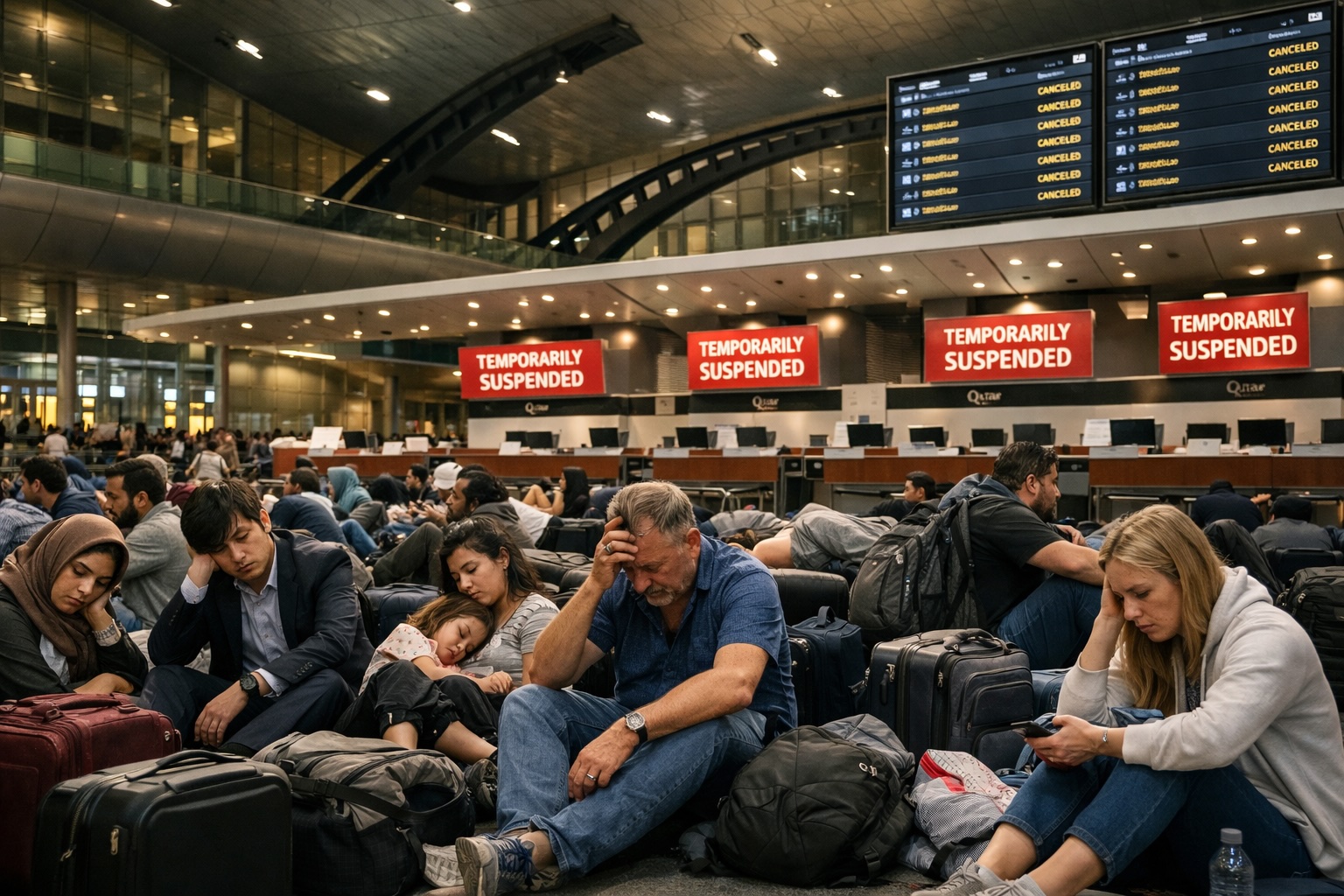
While other carriers rushed to help their customers, Qatar Airways waited nearly a week to offer relief flights as thousands languished in Doha airports
As the Middle East erupted into conflict on February 28, 2026, with US and Israeli strikes on Iran triggering massive airspace shutdowns, one story stands out for all the wrong reasons: Qatar Airways’ inexcusably slow response to help thousands of passengers stranded at Hamad International Airport.
While competitors like Emirates and Etihad Airways scrambled to arrange emergency evacuation flights within days, Qatar Airways left approximately 8,000 passengers abandoned in transit for nearly a week. Today, March 5th, the airline finally began operating limited relief flights – but only after facing intense criticism for its delayed response.
The carrier’s sluggish reaction has sparked outrage among stranded travelers and highlighted serious questions about the airline’s crisis management capabilities.
The Crisis That Exposed Qatar Airways’ Failures
When joint US-Israeli military operations against Iran began on February 28, the resulting airspace closures across Qatar, Iraq, Iran, Kuwait, Bahrain, and parts of the UAE created the largest aviation disruption since the COVID-19 pandemic. According to Paul Charles, CEO of luxury travel consultancy PC Agency, it was “pretty well the biggest shutdown we’ve seen certainly since the COVID pandemic.”
Local reports indicate that around 8,000 passengers have remained stranded in transit at Hamad International Airport since the crisis began, many of them unable to rebook onward journeys because of continuing uncertainty over which routes can safely operate.
Today marks a full week since the crisis began, and Qatar Airways has only just started operating its first relief flights.
The scale of Qatar Airways’ passenger abandonment becomes clear when compared to industry-wide cancellations: according to Flightradar24, some 21,300 flights have been cancelled at seven major airports, including Dubai, Doha and Abu Dhabi, since the strikes started.
Other Airlines Acted Fast – Qatar Airways Did Not
While Qatar Airways passengers suffered in limbo, other major carriers demonstrated what proper crisis response looks like:
Emirates began planning evacuation routes within 48 hours and worked with UAE authorities to establish emergency air corridors, even as Dubai International Airport faced direct missile strikes.
Etihad Airways launched at least 15 evacuation flights from Abu Dhabi by Monday, March 3, carrying passengers to destinations including Islamabad, Paris, Amsterdam, Mumbai, Cairo, and London.
Even smaller carriers like India’s IndiGo arranged around 20 special flights from the UAE to India between March 5-7, showing that airline size wasn’t an excuse for inaction.
Meanwhile, Qatar Airways said it would begin operating a limited number of relief flights from March 5 to help clear a mounting backlog of passengers caught in Doha after days of suspended operations. This announcement came nearly a week after the crisis began – an unconscionable delay that left thousands of people in desperate circumstances.
Stranded Passengers Share Their Horror Stories
The human cost of Qatar Airways’ delayed response is devastating. Passengers describe feeling abandoned by an airline that took their money but failed to provide basic support during a crisis.
Ryan Blackmon, a consultant from Frisco, Texas, told ABC News he was traveling in India for a week on business before getting stranded in Doha, Qatar, on Feb. 28 when “plans changed abruptly.” After nearly two hours into his flight to Dallas Fort Worth International Airport, the plane was forced to return to Doha.
“I have a family back home — and to be here close to a week later is definitely disheartening,” Blackmon, 37, said.
“They say, ‘Get out’, but how do you expect us to get out when airspaces are closed?” said Odies Turner, a 32-year-old chef from Dallas stuck in Doha, Qatar.
Indian technology entrepreneur Varun Krishnan was aboard a Qatar Airways flight on Saturday headed to Barcelona for a conference when it was forced to turn around. Now he’s one of the many travelers stuck in Doha.
These aren’t just travel delays – these are people separated from families, missing critical business meetings, and burning through personal savings while Qatar Airways took its time deciding how to help.
The Compensation Scandal: Passengers Left to Pay
Adding insult to injury, Qatar Airways passengers have discovered they have virtually no rights to compensation or assistance during this crisis. For UK travelers, the situation has raised serious concerns about air passenger rights. Passengers flying on non-European carriers have been left without recourse to compensation or alternative flights as their airlines are not obliged to provide the same level of support as European carriers.
Despite being stranded for days, many of these passengers, including business travelers and holidaymakers, have found little support in terms of accommodation or alternative flights. While Qatar Airways housed some passengers in hotels, many others faced mounting bills for food, accommodation, and rebooking fees.
The stark contrast with European carriers is telling: passengers on flights from Qatar Airways, Emirates, and other Middle Eastern airlines have no legal entitlement to compensation if their flight is canceled or delayed.
Geographic Excuses Don’t Hold Up
Qatar Airways has attempted to justify its delayed response by claiming its geographic position creates unique challenges. Regional aviation specialists say the constraints facing Qatar Airways are particularly severe because Doha sits closer to Iranian-controlled airspace than Dubai or Abu Dhabi.
This excuse falls apart under scrutiny. If geography was the determining factor, why were other airlines able to establish alternative routing faster? While some Gulf carriers have begun cautiously restoring limited services using longer detours over Saudi Arabia and Africa, Doha’s position leaves far fewer options, prolonging the disruption for Qatar Airways customers.
The truth is that Qatar Airways’ response was slow not because of geography, but because of poor crisis management and a lack of urgency in helping stranded passengers.
The Broader Impact of Qatar Airways’ Failures
The airline’s sluggish response has contributed to a broader humanitarian crisis in the region. Of the 36,000 scheduled flights to or from the Middle East since Feb. 28, more than half have been canceled. That equates to about 4.4 million seats.
Thousands of passengers have been stranded in the Gulf region, forcing many to take circuitous, expensive routes to reach functioning airports in Saudi Arabia and Oman.
While other airlines worked with governments to coordinate evacuation efforts, Qatar Airways’ delayed action forced passengers to find their own solutions, often at enormous personal expense.
Government Response Highlights Qatar Airways’ Inadequacy
The contrast between government evacuation efforts and Qatar Airways’ response further exposes the airline’s failures. Multiple countries launched immediate rescue operations:
- Russia: Putin instructed government ministries to organize evacuation flights, with Aeroflot planning multiple flights from the UAE
- France: Organized repatriation flights through Oman and Egypt within days
- Germany: Lufthansa operated an evacuation flight on behalf of the German government via Oman
- India: Arranged 20+ special flights through budget carriers
The US State Department said the first charter flights are starting to take off. Some commercial flights are still taking off intermittently. Yet Qatar Airways, despite being one of the world’s largest carriers and having a massive presence in the affected region, took nearly a week to announce even limited relief operations.
Too Little, Too Late: Qatar Airways’ Belated Response
Today, March 5th – a full week after the crisis began – Qatar Airways finally began operating relief flights for stranded passengers. The limited service includes flights from Muscat in Oman to London, Berlin, Copenhagen, Madrid, Rome and Amsterdam, and Riyadh to Frankfurt.
This response comes only after intense public criticism and pressure from stranded passengers sharing their stories on social media throughout the week. Even now, the airline’s relief operation is embarrassingly limited compared to the scale of the crisis, and the company has provided no apology for the delay, no explanation for the slow response, and no compensation for the thousands of passengers who spent a full week stranded.
What This Reveals About Qatar Airways
The Iran conflict has exposed fundamental problems with Qatar Airways’ crisis management that passengers should consider before booking:
1. Slow Decision Making: While other airlines made rapid decisions to help customers, Qatar Airways took days to even announce a plan.
2. Limited Customer Support: Passengers reported difficulty getting information or assistance from Qatar Airways staff during the crisis.
3. Inadequate Contingency Planning: For an airline operating in one of the world’s most volatile regions, Qatar Airways appeared unprepared for a regional crisis.
4. Poor Communication: The airline failed to provide regular updates to stranded passengers, leaving them in uncertainty for days.
Industry Experts Condemn Qatar Airways’ Response
Aviation industry analysts have been scathing in their assessment of Qatar Airways’ crisis management. Travel consultancy experts note that while all airlines faced challenges during the conflict, Qatar Airways’ response was notably slower and less comprehensive than competitors.
The airline’s reputation as a premium carrier has been seriously damaged by its failure to prioritize passenger welfare during a genuine emergency. For a carrier that markets itself as providing world-class service, leaving 8,000 passengers stranded for nearly a week represents a catastrophic failure of customer care.
The Economic Cost of Qatar Airways’ Delays
Beyond passenger disruption, the cargo impact would run to “billions of dollars”, according to industry experts. Qatar Airways’ delayed response contributed to this economic damage by failing to establish alternative routes quickly enough.
The airline’s sluggish crisis response has also likely cost it future bookings, as passengers consider whether they can trust Qatar Airways to help them during future emergencies.
Looking Forward: Can Qatar Airways Rebuild Trust?
As the immediate crisis begins to stabilize, Qatar Airways faces a massive challenge in rebuilding passenger trust. The airline’s reputation has been severely damaged by its inadequate response to what may have been the most serious aviation crisis since 9/11.
Industry observers note that while operational disruptions were inevitable during the Iran conflict, Qatar Airways’ slow response to helping stranded passengers was a choice – and a poor one that will likely have lasting consequences for the airline’s reputation.
For travelers considering future bookings with Qatar Airways, the airline’s response to this crisis provides important insights into how the carrier prioritizes passenger welfare during emergencies. The exactly week-long abandonment of 8,000 stranded passengers speaks volumes about Qatar Airways’ true commitment to customer service.
The Bottom Line: A Failure of Leadership
While the Iran conflict created unprecedented challenges for all airlines operating in the Middle East, Qatar Airways’ response stands out for all the wrong reasons. When passengers needed their airline most, Qatar Airways failed them with slow decision-making, poor communication, and a clear lack of urgency in providing assistance.
Other carriers proved that rapid, effective crisis response was possible even under these extreme circumstances. Qatar Airways chose differently, prioritizing operational concerns over passenger welfare and leaving thousands of people stranded for exactly one week.
Today’s belated relief flights represent too little, too late. The damage to Qatar Airways’ reputation has already been done, and passengers worldwide have witnessed how the airline treats its customers during genuine emergencies.
The airline industry will study this crisis for years to come, and Qatar Airways’ week-long delay in helping stranded passengers will likely become a textbook example of how not to handle a passenger emergency. For an airline that has spent billions building its reputation as a premium carrier, the Iran conflict may have undone decades of brand-building in just one disastrous week.